
Last updated October 16, 2026
Insulation Warning Signs: A Fresno Homeowner’s Reference Guide
A $40 spike in your July SCE bill is easier to ignore than a visible hole in the wall, but it is often the first and most accurate signal that your attic insulation has a specific, fixable failure point. Most Fresno homeowners do not discover bad insulation by climbing through the attic hatch. They discover it in the living room at 5 p.m. when the air conditioner has been running for six hours straight and the ceiling still feels warm to the touch. That is the moment when a vague worry becomes a diagnosable problem. This guide maps the household symptoms you are already noticing, rooms that run hot, bills that creep upward, odd smells in the hallway, to the specific insulation failures causing them. By the time you finish reading, you will know what is wrong, whether it is urgent, and what it costs to fix in Fresno.
Quick Answer
The most common warning signs of failing insulation in Fresno homes are rooms that stay hot despite a running air conditioner, monthly energy bills that rise year over year without a change in usage, and ceilings that feel warm to the touch in summer. In a two-story home, the upstairs running 8 to 10 degrees warmer than the downstairs almost always points to degraded or missing attic insulation. A written insulation inspection from a qualified contractor can pinpoint the exact section of attic that has failed, often in under an hour. For ongoing care tips, see our Attic Insulation Maintenance Checklist for Fresno Homeowners.
Table of Contents
- Hot Rooms, Cold Rooms: Mapping Symptoms by Location
- The Utility Bill Pattern That Exposes Hidden Insulation Failure
- What to Look For in the Attic: A Layperson’s Checklist
- Pest Damage: Rodent and Wildlife Signs Specific to Fresno
- The Age and Material Matrix: When Decline Is Expected
- HVAC Problems vs. Insulation Problems: The One Test You Can Do
- Moisture and Ice: What Fresno’s Dry Climate Hides
- Common Mistakes to Avoid
- When to Call a Professional
- Frequently Asked Questions
Hot Rooms, Cold Rooms: Mapping Symptoms by Location
Heat does not enter a Fresno home evenly. It follows the path of least resistance, and the path of least resistance is always the spot where insulation is thinnest, missing, or compressed. That is why room-by-room symptom mapping is the single most useful diagnostic tool a homeowner has before anyone opens the attic hatch.
In our experience across Fresno, the pattern is remarkably consistent. When a homeowner tells us the west-facing bedroom is unbearable by 4 p.m., the problem is almost never the window. It is a section of blown-in insulation that has settled or been pushed aside directly above that room. Here is how the typical symptom map plays out:
Symptom Map for Fresno Homes
- Upstairs bedrooms running 8 to 10 degrees hotter than downstairs: This is the classic signature of an attic insulation problem. Heat radiating down from the attic accumulates upstairs first because hot air rises and because the upstairs ceiling is the last barrier between living space and a 130-degree attic in a Fresno summer afternoon. If the upstairs is dramatically hotter, the attic insulation is not doing its job.
- One specific room hotter than all others on the same floor: This points to a localized failure: a section where insulation was removed during a repair and never replaced, a spot where a roof leak soaked and compressed the material, or a rodent nesting area. The heat is not distributed; it is concentrated.
- Rooms on the west side of the house consistently hotter in late afternoon: Some of this is solar gain on the walls and windows, but if the west rooms are disproportionately hot compared to east rooms even after sunset, the attic insulation above those rooms is likely thin. The attic over the west side absorbs hours of direct afternoon sun, and the insulation there works harder than anywhere else in the house.
- A hallway or stairwell that feels like a wall of heat: In homes with a central stairwell, heat in the attic is drawn down the stairwell as cooler air is drawn up. If the stairwell feels like a furnace, the attic is likely under-insulated, and the stairwell is acting as a chimney.
What This Tells You About the Attic
Heat mapping is not just about comfort; it is about identifying which section of attic insulation has failed before anyone climbs up there. When a homeowner tells us the master bedroom is the only hot room, we know to check the attic section directly above the master bedroom first. That saves time, and it means the problem is usually contained and fixable in a single visit rather than a whole-attic project. Attic insulation in Fresno fails in sections far more often than it fails uniformly, and knowing which section is the culprit is half the job.
The Utility Bill Pattern That Exposes Hidden Insulation Failure
A single high electric bill proves nothing. A heat wave spikes every bill in the neighborhood. What we tell Fresno homeowners to look for is not a one-month anomaly but a rolling 12-month pattern that shows your home losing ground in efficiency relative to itself.
The 12-Month Trend Test
- Pull your last 24 months of bills, or as many as you can access through your SCE online account. Write down the total kilowatt-hours used for each summer month: June, July, August, September.
- Compare each summer month to the same month one year earlier. If July of last year used 1,800 kWh and July of this year used 2,100 kWh, that is a 16% increase. One year of that increase could be a hotter summer. Two consecutive years of the same upward trend is a problem.
- Check your winter months too. In Fresno, winters are mild but not free. If your gas or electric heating usage is also climbing year over year, the insulation is failing in both directions: it is letting heat in during summer and letting heat out during winter.
- Look for the base load drift. Even your spring and fall bills, when the HVAC runs the least, will show a small but steady increase if insulation is degrading. A home with failing insulation costs more to keep at a stable temperature all year, not just in July and August.
Why a Trend Matters More Than a Spike
Insulation does not fail in a single dramatic event, except in cases of major roof leaks or pest damage. It declines a little each year: fiberglass batts sag and lose loft, blown-in cellulose settles and compacts under its own weight, spray foam can deteriorate under prolonged exposure to Fresno’s attic heat. Each year of decline shows up as a small increase in energy use. A 3% increase per year does not trigger alarm bells, but over five years that is a 15% efficiency loss that most homeowners never notice because they adapt to the higher bills. The 12-month trend test catches what a single inspection can miss: slow, cumulative degradation.
What to Look For in the Attic: A Layperson’s Checklist
You do not need to be an insulation contractor to do a basic visual check. In fact, ten minutes with a flashlight at the attic hatch can give you enough information to know whether a professional visit is worth scheduling. Here is what to look for, and what each finding means:
The Attic Hatch Checklist
- Visible joists: In a properly insulated attic, the floor joists should be covered. If you can see the tops of the joists across wide sections of the attic, the insulation is not deep enough. In Fresno’s climate, most attics should have at least 12 to 15 inches of blown-in material or the equivalent R-value in batts.
- Uneven or lumpy surface: Blown-in insulation should look fairly uniform, like a light snowfall. If you see bare patches, heavy clumps, or areas where the material looks matted down, something has disturbed it: a roof repair, a pest, or a past leak.
- Dark streaks or staining: Dark gray or black streaks in insulation, particularly near the eaves or under vents, are usually a sign of air movement. Air is flowing through or around the insulation, and the material is filtering dust and soot out of that air. This is called wind washing and it reduces the effective R-value.
- Damp or musty odor: Your nose is a legitimate diagnostic tool. If the attic smells musty or earthy, there is moisture somewhere. In Fresno’s dry climate, attic moisture almost always comes from a specific source: a roof leak, a bathroom exhaust fan venting into the attic instead of outside, or a plumbing vent issue.
- Compressed areas under storage: If you have plywood laid across joists for storage, any insulation under those boards is compressed to a fraction of its intended thickness. Compressed fiberglass loses most of its R-value. This is one of the most common, and most ignored, insulation failures in Fresno homes.
A quick note on safety: a visual check from the hatch is fine for most homeowners. But if you intend to walk around in the attic, be aware that stepping between joists can put a foot through the ceiling drywall below. If you are not comfortable navigating attic framing, have someone experienced do the inspection. That is what we do every day, and part of why Woolsey Insulation Fresno home inspections include a written report with photos so you can see exactly what we see.
Pest Damage: Rodent and Wildlife Signs Specific to Fresno
Fresno’s warm climate supports a healthy population of roof rats, mice, and squirrels, and attics are their preferred nesting habitat. Rodent activity in attic insulation is one of the most damaging insulation problems a homeowner can face, not just because of the insulation damage but because of the health and electrical issues that come with it. Here is how to spot pest activity before it becomes a full infestation.
The Fresno Pest Indicator Checklist
- The smell test: Rodent urine has a sharp, ammonia-like smell that gets stronger in warm weather. In a Fresno summer, an attic with active rodent activity will often smell noticeably stronger in the late afternoon when the attic is hottest. If you notice a persistent musty-ammonia smell near the attic hatch or in upper hallways, investigate.
- HVAC filter debris: If rodents are nesting in the attic, the HVAC system draws air through the attic space, and fine debris from their nests gets pulled into the returns. Check your HVAC filter. If you see small bits of insulation, seed husks, or gnawed material that was not there before, rodents have been active in the attic. This is a sign most Fresno homeowners miss, and it is one we have learned to ask about on every inspection.
- Ceiling stain patterns: Rodent nests generate moisture and waste that soaks into the insulation and eventually into the drywall below. The stain pattern is distinctive: small, scattered spots rather than one large water stain, often accompanied by a faint yellow or brown tint and a musty smell. If you see multiple small stains across a ceiling, particularly in corners or near the eaves, suspect rodents.
- Disturbed insulation at the edges: Rodents tend to tunnel along the edges of the attic, near the eaves and around penetrations like vent pipes. If the insulation looks pushed around, with the edges of tunnels visible from the hatch, they have been active. Rats and mice in Fresno especially favor the warm zone near recessed light fixtures and vent pipes.
- Noises at dawn and dusk: Roof rats are most active at dawn and dusk. Scratching, scurrying, or thumping from the attic during these hours is the most direct evidence you will get. If you hear it once, act. A single pair of rats can produce dozens of offspring in a year, and the insulation damage compounds quickly.
What Pest-Damaged Insulation Means for Your Home
Rodent-damaged insulation loses its R-value for two reasons: the physical tunneling compresses and displaces the material, and the urine and droppings contaminate it. In most cases, contaminated insulation should be removed and replaced entirely. This is a specialized removal process, and it is not a job most homeowners should attempt on their own due to the health risks of rodent waste. In Fresno, where roof rats are a known regional pest, we see this issue regularly, and we recommend professional removal and replacement followed by sealing of the entry points.
The Age and Material Matrix: When Decline Is Expected
Not every insulation failure is premature. Some materials simply reach the end of their useful life under Fresno’s specific heat conditions. Knowing what is in your attic and how old it is tells you whether the decline you are seeing is a defect or just time doing what time does. For seasonal timing on inspections and upgrades, see our Seasonal Insulation Care for Fresno: Year-Round Homeowner’s Guide.
Expected Lifespan by Material, Under Fresno Conditions
- Fiberglass batts: 20 to 30 years under normal conditions, but Fresno’s extreme attic heat accelerates the breakdown of the binder that gives batts their loft. In attics that regularly reach 130 degrees or higher, fiberglass batts can lose significant R-value within 15 to 20 years. The batts sag, pull away from the framing, and leave gaps at the edges.
- Blown-in fiberglass: Similar to batts but more prone to settling. Blown-in fiberglass can lose 10% to 15% of its installed R-value in the first five years just from settling, and that number compounds over time. Most blown-in fiberglass installed 15 or more years ago in Fresno is now performing well below its rated R-value.
- Blown-in cellulose: Cellulose, like the products we install from spray foam insulation in Fresno alternatives such as GreenFiber and Johns Manville, is treated with borates that resist pests and fire. It settles more than fiberglass initially, but it maintains its R-value longer in high heat. Expect 20 to 25 years of good performance in Fresno, longer if it was installed to a higher initial depth.
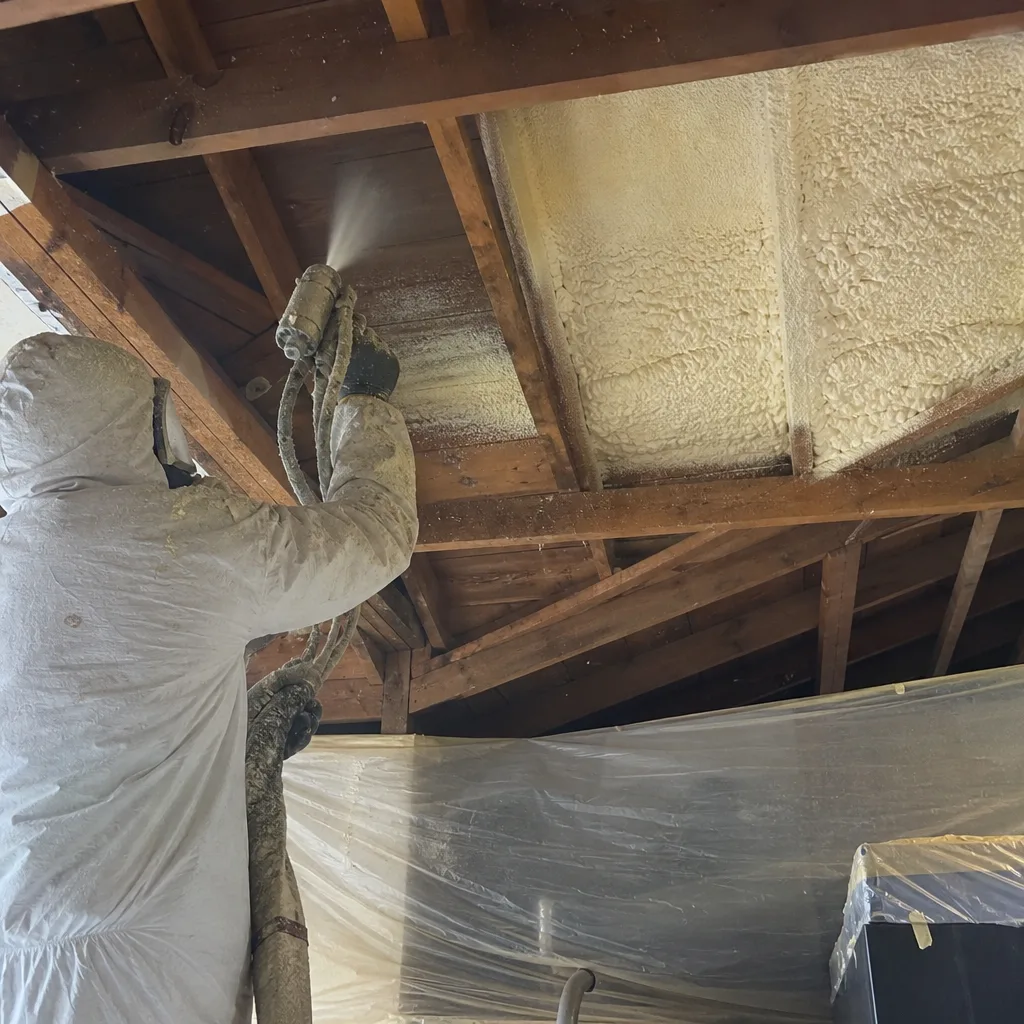
- Spray foam: Closed-cell spray foam, including options from Demilec, is the most durable insulation material available, and it is the one best suited to Fresno’s attic heat. It does not settle, sag, or lose loft over time. Under normal conditions, closed-cell spray foam can maintain its R-value for the life of the home. The failure points are installation-related: improper mixing, missed sections, or shrinkage if the foam was installed incorrectly. Open-cell spray foam is less durable and more susceptible to moisture, but it still outperforms batts in high heat.
How to Determine What You Have
If you do not know what type of insulation is in your attic, the age of your home is a reasonable proxy. Homes built before 1980 in Fresno typically have fiberglass batts or, in some cases, rock wool. Homes built between 1980 and 2000 often have blown-in fiberglass. Homes built after 2000 may have blown-in cellulose or, in some cases, spray foam. But this is a rough guide only; plenty of older Fresno homes have been re-insulated over the years. A quick look at the material itself is the only reliable way to know.
Here is the practical takeaway: if the insulation in your Fresno attic is more than 15 years old and you are seeing the symptom patterns described earlier in this guide, the decline you are seeing is likely age-related and normal. That does not mean you should live with it; it means the fix is well understood and straightforward. If the insulation is less than 10 years old and failing, something specific happened, and a professional should look at whether it was installed correctly in the first place or whether a roof leak or pest problem needs addressing.
HVAC Problems vs. Insulation Problems: The One Test You Can Do
This is the most common diagnostic confusion we hear from Fresno homeowners. The air conditioner is running all day, the house is hot, and the natural assumption is that the AC is failing. Sometimes it is. Often it is not. An undersized or aging AC unit and failing insulation produce nearly identical symptoms: rooms that never cool down, bills that climb, a system that runs constantly.
The One-Hour Shutdown Test
Here is the test you can do without a thermometer, without calling anyone, and without spending a dollar. On a hot Fresno afternoon, when the temperature outside is above 95 degrees and your AC has been running normally all day:
- At 4 p.m., turn the air conditioning off completely. Set the thermostat to “off,” not just a higher temperature.
- Leave it off for one full hour. Go about your normal activities in the house. Do not open windows. Do not run fans that pull air from the attic.
- At 5 p.m., feel the walls and ceiling with the back of your hand in the room that normally runs hottest. Then go to a different floor if you have one, and feel there too.
- Compare the temperature rise. A home with good insulation will hold its temperature for that hour, rising perhaps 2 to 4 degrees. A home with failing insulation will rise 6 to 10 degrees or more, and you will feel the heat radiating from the ceiling and upper walls.
Reading the Results
If the house heats up quickly when the AC shuts off, the problem is thermal, not mechanical. Your AC unit may be working perfectly, but the house cannot hold the cool air it produces. That is an insulation problem. If the house holds temperature well during the test, but you still have rooms that never cool down, the problem is more likely the HVAC system: unbalanced ducts, an undersized unit, or a dirty coil.
The key insight: insulation determines how fast your home loses the cool air it already has. The air conditioner determines how fast it can replace that cool air. If the AC runs constantly and the house still warms up within an hour of shutdown, no amount of AC repair will fix the real problem. The house is leaking its conditioned air faster than the system can replace it, and the leak is almost always in the attic.
Moisture and Ice: What Fresno’s Dry Climate Hides
Fresno is a dry place. That dryness is both a blessing and a diagnostic problem. In humid climates, moisture problems in the attic announce themselves with visible mold, rot, and dripping condensation. In Fresno, the same level of moisture damage can exist for years without ever looking wet because the surrounding air is so dry it evaporates the surface moisture before it becomes visible.
What Fresno’s Dry Air Conceals
- Slow roof leaks: In a humid climate, a small roof leak stains the ceiling within weeks. In Fresno, a slow drip onto the insulation can evaporate before it ever reaches the drywall. The insulation gets damp, loses its loft and R-value, and eventually develops mold, but the homeowner never sees a stain. By the time the leak is discovered, the insulation above the affected area is ruined.
- Bathroom fan venting into the attic: This is a code violation, but it is common in older Fresno homes, particularly those where a previous owner did a DIY bathroom remodel. The fan dumps warm, moist air into the attic, where it condenses on the underside of the roof deck and drips back down onto the insulation. In the dry Fresno summer, this moisture evaporates quickly enough that it is hard to see. By winter, the insulation in that attic section is damp, matted, and far less effective.
- Condensation on can lights and vent pipes: During Fresno’s cooler winter mornings, the temperature difference between the warm attic air and cold metal vent pipes can cause condensation to form. If your attic is under-insulated, that condensation drips onto the insulation below. Over time, this creates a localized damp zone that compresses the insulation and reduces its performance.
The Dry Climate Paradox
The dryness that makes Fresno summers relatively comfortable compared to the Gulf Coast also makes attic moisture problems harder to catch. The lesson: do not assume your attic is dry just because you have not seen a stain. If you have had any roof work done in the past five years, any bathroom fan installed without roof venting, or any recurring musty smell in the upper rooms, have the attic inspected. The cost of catching a moisture problem early is a fraction of the cost of replacing a section of ruined insulation and the drywall below it.
Common Mistakes to Avoid
We see the same mistakes repeated across Fresno attics, and almost all of them are avoidable. Here is what to watch for:
- Assuming the AC is the problem when the house is hot. As we covered in the shutdown test section, an AC unit that runs constantly but cannot hold temperature is often paired with a house that is leaking its conditioned air. Replacing the AC before fixing the insulation is the single most expensive mistake you can make. The new unit will be oversized for the load, which causes short cycling and early failure, and the house will still be hot.
- Adding new insulation on top of old, damaged, or pest-contaminated insulation. It is tempting to think of insulation as a topping that can just be added to. In some cases, adding new blown-in material over old fiberglass batts can work. But if the old insulation is damp, moldy, pest-infested, or heavily compressed, adding new material on top simply buries the problem. The old material must come out first.
- Blocking attic ventilation. Some Fresno homeowners, in an effort to keep pests out or keep the attic warmer in winter, seal off their attic vents. This traps heat and moisture in the attic, which accelerates insulation degradation and can cause roof deck warping. Attics in Fresno’s climate need airflow, particularly the soffit and ridge vent system.
- Ignoring one hot room because “it has always been that way.” A room that has always run hot is still a room with a problem. The fact that the problem is old does not make it less fixable. The fix is often simpler than homeowners expect: a section of attic above that room that never got proper insulation coverage in the first place.
- Doing the whole job DIY to save money. Blowing insulation into an attic looks straightforward, and in small, simple attics it can be done by a determined homeowner. But without proper depth measurement, air sealing around penetrations, and attention to soffit vent baffles, a DIY job can leave the home worse off than before. We have been called to fix many DIY jobs that looked fine from the hatch but were riddled with gaps and missed sections.
- Not asking for a written price before work starts. This is less an attic mistake than a contractor mistake. In a trade where some operators change the price at the door, the simplest protection a homeowner has is a written price before any work begins. If a contractor will not put the number in writing, that is a signal.
When to Call a Professional
Some insulation problems are worth tackling on your own: adding a roll of batting in a small, clearly identified gap, re-securing a fallen batt, checking that the attic hatch is properly sealed. But these situations warrant a professional visit:
- Pest-contaminated insulation: Rodent waste in insulation requires removal with proper protective equipment. This is a health matter, not a handyman matter.
- Suspected moisture damage: If you see any staining, smell mustiness, or suspect a roof leak, a professional can identify the moisture source and assess the damage.
- Whole-attic insulation replacement or significant topping: The difference between a good whole-attic job and a mediocre one is in the details: depth consistency, air sealing, vent baffles, and edge coverage. These details determine whether the job works.
- Spray foam installation: Spray foam is a chemical product that requires specialized equipment and training to install correctly. An improper spray foam job can off-gas, shrink, and fail in ways that are expensive to fix.
- Any job where you want a guarantee in writing: The Kingswell Way means a written price before work starts, a committed arrival window, a clean job site, and a written guarantee on the work. Woolsey Insulation Fresno offers free estimates in Fresno, call (559) 785-2658, and every estimate tells you exactly what is wrong and what it costs to fix, in writing, before you decide anything.
Frequently Asked Questions
Bad attic insulation shows up as rooms that stay hot despite a running air conditioner, ceilings that feel warm to the touch in summer, and energy bills that rise year over year without a change in usage. Perform the one-hour shutdown test described above: if your home heats up quickly after the AC turns off, the insulation is not holding the cool air in.
Most attic insulation removal and replacement jobs in Fresno run between $1,800 and $4,500 depending on the size of the attic, the type of material, and whether pest contamination or moisture damage requires special handling. Topping up existing blown-in insulation is less expensive, typically $800 to $2,000. Woolsey Insulation Fresno gives a written price before any work starts, so you know the exact number before the crew arrives. Call (559) 785-2658 for a free estimate.
Fresno’s extreme attic temperatures shorten insulation lifespan. Fiberglass batts can lose meaningful R-value within 15 to 20 years of installation here, and blown-in fiberglass settles and loses loft even faster. Blown-in cellulose from brands like GreenFiber typically lasts 20 to 25 years. Closed-cell spray foam from manufacturers like Demilec is the most durable option and can maintain its R-value for decades under Fresno conditions.
In many cases, yes, and this is a cost-effective way to restore R-value without a full removal. The exception is when the old insulation is damp, moldy, pest-contaminated, or heavily compressed. In those situations, the old material must be removed before new insulation goes in. A professional inspection can tell you which situation you have. Call (559) 785-2658 to schedule one in Fresno.
Heat rises, and in a Fresno summer your attic can reach 130 degrees or more. The upstairs ceiling is the last barrier between that heat and your living space. If the upstairs runs 8 to 10 degrees warmer than the downstairs, the attic insulation is almost certainly insufficient, settled, or missing in sections. This is one of the most common and most fixable problems we see in Fresno homes.
For small, clearly identified gaps, a DIY fix with batts can be cheaper. For whole-attic projects, spray foam work, or pest or moisture damage, professional installation is almost always more cost-effective in the long run. DIY blow-in jobs often miss air sealing and depth consistency, which means the home underperforms and the job often has to be redone. Every Woolsey job includes a written guarantee and a free return visit if the work fails within 365 days, so the price you pay is the price of it being done right.
The Bottom Line
Failing insulation in a Fresno home rarely announces itself from the attic hatch. It shows up in the living room at 5 p.m., in the upstairs bedroom that never cools down, in the electric bill that drifts upward year after year. The good news is that these symptoms are diagnosable. Hot rooms map to specific attic sections. A 12-month bill trend reveals gradual degradation. A simple one-hour shutdown test separates insulation problems from HVAC problems. And in every case, the fix is known, the lifespan of the material is predictable, and the cost is calculable. If the symptoms in this guide sound familiar, start with a written inspection, and explore more guides & resources to keep your home efficient year-round. It costs nothing to have the attic evaluated, and knowing what is wrong is the only way to fix it right the first time.
Written by Glenn Hartley, Owner at Woolsey Insulation Fresno, serving Fresno since 2002.