
Last updated October 16, 2026
The Complete Guide to Insulation in Fresno
Fresno averages 105°F days in July and 29°F nights in January. That’s a 76-degree swing between seasons, and it’s the reason most insulation advice written for California gets Fresno wrong. Coastal guides tell you to insulate for heat. Fine. But the same attic that hits 140°F in August drops below freezing on a clear January night, and a home optimized only for summer cooling bleeds heat all winter. This guide covers what actually works in Fresno’s dual-extreme climate: the R-values that make sense here, the materials that perform differently under a Central Valley sun, and the order you should tackle the zones of your home. We’ll also walk through what Title 24 requires versus what actually lowers a Fresno utility bill, and where it’s smarter to repair rather than replace. If you own a home in Fresno, this is the insulation reference we wish every homeowner had before making a decision.
Quick Answer
The right insulation strategy for a Fresno home means treating both extremes: attic insulation of at least R-38 to R-49 (not the R-30 coastal minimum), plus an air seal, handles the summer heat and the winter cold together. Most attic insulation jobs in Fresno run between $1,800 and $4,200 depending on square footage and material, and spray foam runs higher but seals air gaps batts can’t touch. For a detailed look at what drives these numbers, see our Insulation Cost Breakdown: The Fresno Homeowner’s Reference for 2026. The single highest-impact upgrade for most Fresno homes is the attic floor, because that’s where both your cooled summer air and your heated winter air escape most aggressively.
Table of Contents
- Why Fresno’s Climate Breaks Standard Insulation Advice
- The R-Values That Actually Work in Fresno
- The Attic Floor: Fix This First
- Batt vs. Blown-In vs. Spray Foam: What Wins Where in Fresno
- Title 24 vs. Actually Lowering Your Fresno Utility Bill
- The Right Order to Insulate a Fresno House
- What Insulation Costs in Fresno
- Common Mistakes to Avoid
- When to Call a Professional
- Frequently Asked Questions
- The Bottom Line
Why Fresno’s Climate Breaks Standard Insulation Advice
Fresno sits in the San Joaquin Valley, which acts like a bowl that traps air. In summer, that means weeks of triple-digit heat with low humidity. In winter, the same geography produces cold air drainage off the Sierra foothills that settles into the valley, and clear January nights routinely dip below freezing. A home in Fresno experiences both radiant heat gain from a sun-blasted roof and conductive heat loss through the attic on cold nights. Most insulation guidance published for California assumes a coastal climate: mild winters, warm summers, and a primary enemy of afternoon sun. That’s the wrong assumption for Fresno, and it shows up in homes every year with attics insulated to coastal minimums and owners wondering why their January heating bill spiked.
What this means practically is that Fresno homeowners need to plan for two separate failure modes: heat intrusion from above in summer and heat escape through the ceiling in winter. Batts that sag or settle create cold spots along the ceiling in January. Air leaks around can lights and attic hatches pull conditioned air upward year-round. And a roof that radiates 140°F heat into the attic in August demands a different response than one in a foggy coastal city that never gets above 90°F. We’ve seen this in attics across Fresno: the same house with R-30 batts performs fine in May, then the bill jumps in December because the cold side was never the design consideration.
One more thing most guides miss: Fresno’s low humidity means your attic is dry, which is good news for insulation performance. Fiberglass batts hold their R-value better in dry air than in humid coastal air. But the dry air also means static and dust accumulate faster in batts, and loose dust with no moisture fights you in an attic year-round. Choosing a material for Fresno means accounting for dry, dusty conditions, not just temperature.
The R-Values That Actually Work in Fresno
R-value measures resistance to heat flow. Higher numbers mean better resistance. The California Energy Code (Title 24) sets minimums for new construction and additions, but minimums are a floor, not a target. For existing Fresno homes, what matters is what stops the heat you’re paying to create or remove from leaving the building envelope. Here’s what we recommend for Fresno specifically:
- Attic floor (flat ceiling, vented attic): R-38 to R-49. That’s roughly 12 to 16 inches of blown-in fiberglass or cellulose, or up to 20 inches of loose-fill. Coastal guides often say R-30 is fine. It isn’t for Fresno winters.
- Attic with a room or finished space above (knee walls and slopes): R-30 to R-38, and that’s where spray foam starts to earn its keep because you’re insulating a sloped roof deck, not a flat floor.
- Walls (if you’re opening them anyway): R-13 to R-15 in a 2×4 cavity, R-21 in a 2×6. Walls matter less than the attic in Fresno because heat rises and the attic is the main path for both summer gain and winter loss, but under-insulated walls in older Fresno homes are a real source of cold rooms in January.
- Floors over crawl spaces: R-19 to R-30, especially if your crawl space is vented to the outside air.
Here’s the nuance most guides skip. Radiant heat from Fresno’s composition shingle and tile roofs behaves differently depending on the material beneath the roof deck. A tile roof radiates heat downward for hours after sunset. A composition shingle roof absorbs and re-radiates during the day. A radiant barrier stapled to the underside of the rafters can reflect a meaningful portion of that heat before it reaches your insulation, but it works only if there’s an air gap and it degrades if dust coats the shiny surface. Fresno’s dry, dusty attics coat radiant barriers within a few years, which is why we often recommend dense-packed material instead of relying on reflection alone.
The Attic Floor: Fix This First
If you do one single insulation upgrade in a Fresno home, make it the attic floor. Here’s why: heat rises. In winter, every bit of heated air you’re paying for is fighting its way up through the ceiling, through any gaps and thin insulation, into the attic, and out through the roof vents. In summer, the opposite happens: a 140°F attic radiates heat down through the ceiling into your living space like a broiler. The attic floor is the largest single surface separating your conditioned living space from unconditioned air in the entire house. Fixing it first delivers the biggest bill reduction per dollar spent in nearly every Fresno home we’ve worked in.
Most Fresno homes have some insulation in the attic already, but it’s often R-19 batting from the 1980s or 1990s, compressed under storage or foot traffic, or blown in at R-30 with no air seal. Old insulation doesn’t always need to be removed. In a dry Fresno attic, old fiberglass can often stay in place and be topped with additional blown-in material to reach R-49. What needs attention before toppping anything is the air seal: the gaps around recessed light fixtures, the attic hatch, ceiling fans, partition walls, and any penetration for plumbing or electrical. Without sealing these, adding insulation is like putting on a heavier coat but leaving the zipper open.
In our experience completing attic insulation upgrades across Fresno neighborhoods from Bullard to Sunnyside, the homes that see the most dramatic bill changes after attic work share two traits: the ceiling had can lights without air-tight housings, and the attic hatch was a piece of unpainted drywall with no weatherstripping and no insulation on top. If you’re weighing whether to tackle this yourself or hire out, our DIY vs Professional Insulation: The Fresno Homeowner’s Decision Guide walks through what each path actually involves. Sealing those two things alone can stop a steady stream of conditioned air from leaving the house year-round.
Batt vs. Blown-In vs. Spray Foam: What Wins Where in Fresno
Insulation comes in three broad families and each behaves differently under Fresno’s conditions. Here’s how to think through the choice without getting lost in marketing.
Fiberglass batts are pre-cut blankets, typically pink or yellow, that fit between joists and studs. They’re inexpensive, easy to install, and in Fresno’s dry air they hold their rated R-value well. But batts only work as well as the installation. A batt that’s compressed, turned, or sliced around a pipe loses meaningful R-value. Batts also don’t stop air movement. In a dusty, drafty Fresno attic, batts installed on an unsealed floor let warm air rise right through the gaps between batt edges. Where batts still make sense in Fresno: walls during a remodel, crawl space floor cavities, and spots where you need to pull insulation back for access and put it back again.
Blown-in insulation is loose material, usually fiberglass or cellulose, blown into place with a machine. It fills irregular spaces better than batts, covers gaps, and when installed to R-38 or R-49, it’s the workhorse of Fresno attic floors. Cellulose, made from recycled paper treated with borate, settles slightly over time but dense-packs well and performs strongly in the dry Central Valley air. GreenFiber is a cellulose brand we install in Fresno attics, and it does an excellent job filling around attic framing in the older homes common in the Tower District and Fig Garden. The one thing blown-in can’t do is seal air leaks, so it should always be paired with an air seal first. For a deeper look at how blown-in insulation works in Fresno attics, see our Attic Insulation in Fresno page.
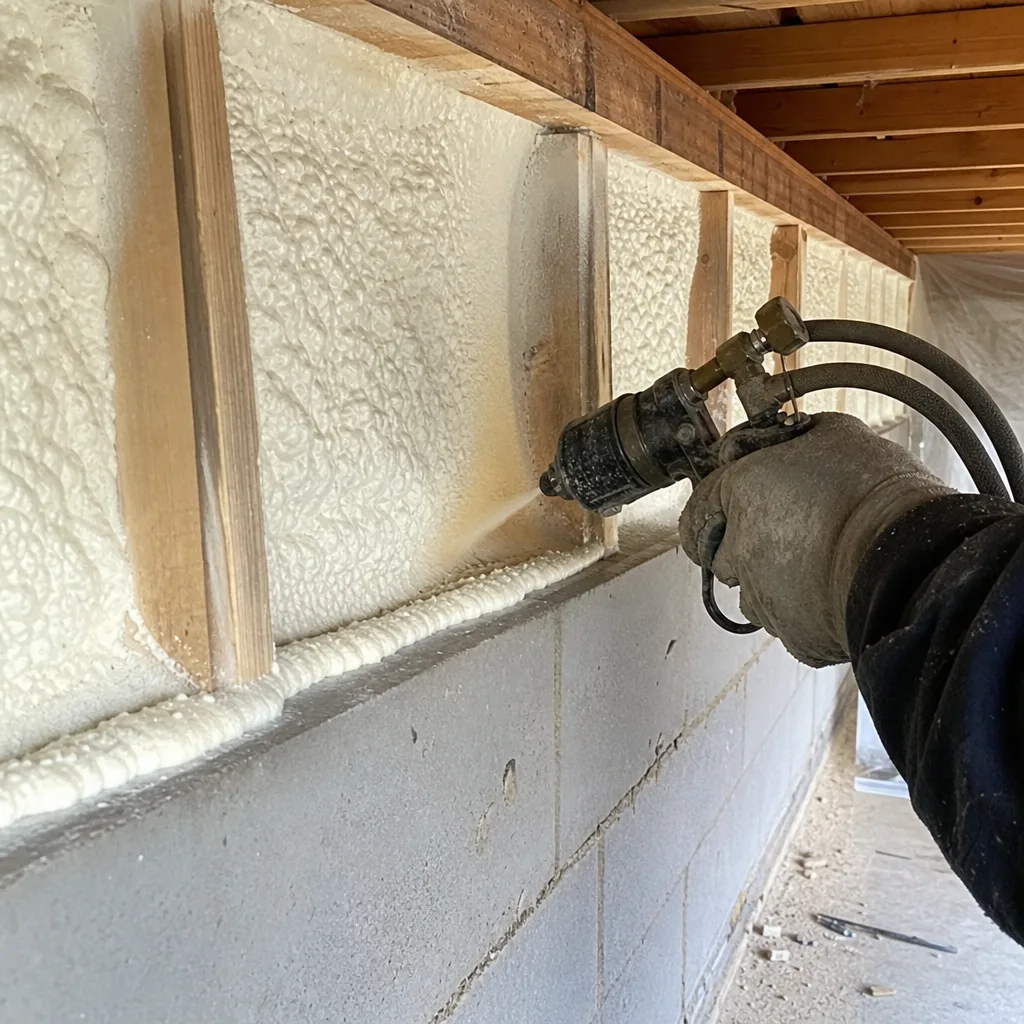
Spray foam insulation is a two-part liquid that expands on contact and seals gaps airtight. It comes in two forms: open-cell (softer, lower R-value per inch, excellent air seal, good sound control) and closed-cell (denser, higher R-value per inch, acts as a moisture barrier). In a Fresno attic, spray foam earns its keep in limited but important situations: finished attic rooms with knee walls, unvented attic designs, areas where you need to seal around difficult penetrations, and rim joists above a crawl space. Icynene and Demilec are two spray foam brands we install. Spray foam costs more per square foot than blown-in, often two to three times, but it seals in a way no loose-fill material can. For the standard flat-ceiling vented attic in Fresno, blown-in over an air seal is usually the cost-effective choice; spray foam wins when the attic is part of the living envelope. We break down the materials and when spray foam is worth the premium on our Spray Foam Insulation in Fresno page.
Title 24 vs. Actually Lowering Your Fresno Utility Bill
Title 24 is California’s building energy code. In Fresno, which sits in climate zone 13 along with much of the warm Central Valley, the code sets insulation minimums for new construction and major remodels. Here’s what homeowners often misread about Title 24: it is a minimum legal floor for new work, not a recommendation for what actually lowers a utility bill in an existing home. A home built in 1975 with R-19 attic batting and single-pane windows may not need any code compliance work until there’s a significant permit-pulled remodel. That means compliance and comfort are two different conversations.
Specifics: Title 24 for new construction in Fresno climate zone 13 generally requires R-38 attic insulation for most standard construction, along with mandatory measures like radiant barrier in some cases and air sealing verification. But the code’s air sealing requirements for new homes address the fact that a leaky envelope in a Fresno summer is a major energy drain. For an existing older home, none of those new-home standards matter until a permit is pulled. What does matter is what your actual ceiling and wall situation is doing to your bill. In our experience, many Fresno homeowners fix the wrong thing first: they upgrade windows before touching their attic, not realizing the attic is a far larger and cheaper win per dollar. If you’re ready to hire, our How to Hire a Insulation Contractor in Fresno: A Step-by-Step Guide covers what to ask before signing. Title 24 compliance matters when you’re doing permitted work. Lower bills are a separate question, and the answer usually starts with the attic, not the windows.
One more nuance. Fresno’s PG&E and Pacific Power rates have shifted in recent years toward time-of-use billing, which penalizes electricity use during summer afternoons and early evenings. An attic at R-19 or lower means your air conditioner runs longer during the most expensive hours. Upgrading that attic to R-49 with a proper air seal has an outsized effect on those peak-rate hours, because the ceiling is the single largest surface in the house exchanging heat with unconditioned air during the hottest part of the day.
The Right Order to Insulate a Fresno House
Homeowners tend to fix insulation in the order they notice problems: a cold bedroom in winter gets a wall insulation estimate, a hot upstairs room gets a radiant barrier pitch. That’s backwards. Insulation zones should be prioritized by how much heat they exchange, not by which room complains the loudest. Here’s the order we recommend for a typical single-story Fresno ranch house, which is a common layout in neighborhoods like McLane and Sunnyside:
- Attic floor and air seal, first. This is the single largest surface between conditioned air and the outdoors. Seal gaps at the attic hatch, can lights, and partition walls, then blow insulation to R-49. This change alone, on the average Fresno house, is typically the most visible difference per dollar spent, both in summer and January, on the same bill.
- Attic hatch itself. Most Fresno homes have a hatch that’s just a piece of drywall or plywood, no weatherstripping, no insulation on top. That one small opening leaks conditioned air like a chimney. Insulate and weatherstrip it as part of step one; it should never be skipped.
- Crawl space rim joists. If your home has a perimeter foundation with a vented crawl space, the rim joist is the band around the floor framing where cold or hot outside air seeps in. Sealing and insulating the rim joists with spray foam or rigid board is a quick win on winter bill in Fresno.
- Knee walls and sloped sections, if you have a 1.5-story home or finished attic. These surfaces touch both the roof and the living space and often have batt insulation installed backwards or not at all. In Fresno’s summer, a south-facing knee wall gets punished, and the room behind it feels it.
- Walls, as part of larger work. Unless walls are open during a remodel, do not prioritize them over the attic. In a 2×4 wall cavity, blown-in or injection foam can improve things, but the ceiling above loses more. Walls come after the attic has been brought to R-49 and the crawl space sealed.
- Floors over an unconditioned space. Garage ceilings and floors over a basement (rare in Fresno) or an open carport need attention at this stage, when the primary paths are already handled.
This order isn’t guesswork. It’s based on the physics of where heat actually moves in a Fresno house, which is primarily up through the ceiling and down through the attic in summer, with rim joist leaks and uninsulated hatches as secondary but real losses. We’ve walked through enough of these homes to tell you: fixing them in this order costs less overall than beginning with the room that complained first.
What Insulation Costs in Fresno
Here’s what we tell Fresno homeowners when they ask about price. Most attic insulation jobs in Fresno run between $1,800 and $4,200, depending on the attic’s square footage, the depth of the material you’re targeting, and whether air sealing is included. A smaller ranch attic may come in lower; a large 2,500-square-foot two-story house with a complicated attic layout may exceed that range. Spray foam jobs run higher because the material itself is more expensive and the installation is more labor-intensive, often starting around $4,000 for a small to medium attic and rising from there for larger spaces.
The important number isn’t the range. It’s the written price you should get before any work starts. That’s the part of the insulation buying process where Fresno homeowners get hurt most often: a ballpark figure over the phone, then a different number at the door. We don’t work that way. A written price is delivered before work starts, every single time. Here’s a typical breakdown for a Fresno attic floor at R-49 with blown-in insulation:
- Air sealing (can lights, hatch, partition walls, penetrations): $400 to $900, depending on the number of fixtures and gaps.
- Blown-in insulation to R-49 (about 16 to 18 inches): $1,200 to $2,800, depending on square footage and material (fiberglass or cellulose).
- Attic hatch insulation and weatherstripping: $100 to $250.
- Total, typical Fresno attic: $1,800 to $4,200.
What’s most important is that the exact number is written down before we start, and the price doesn’t change unless you request work beyond the scope. That’s what we mean when we say the price is in writing, period. If you want to understand the details of a Fresno attic insulation installation, you can read more on our Attic Insulation in Fresno page.
Common Mistakes to Avoid
Here are the insulation mistakes we see repeatedly in Fresno homes, the ones that cost homeowners money and comfort.
- Insulating to a coastal R-value. R-30 sounds fine if you read a generic California guide. In Fresno’s winter, R-30 leaves your ceiling as the cold spot every January night. Target R-49.
- Adding insulation without air sealing first. Blown-in over a leaky attic floor is a heavier blanket with the window open. All you’ve done is hide the gaps.
- Focusing on windows before the attic. New double-pane windows in Fresno help, but a Fresno attic at R-19 loses more conditioned air than all your windows combined. The attic comes first.
- Ignoring the attic hatch. In a typical Fresno attic, the uninsulated hatch is one of the most concentrated leaks in the whole house. Nobody sees it, so nobody fixes it.
- Putting a radiant barrier in a dusty attic without an air seal. In Fresno’s dry, dusty conditions, the shiny surface degrades within a few years. Solve the air seal and insulation depth first, then consider a barrier if there’s still a problem.
- Choosing a material based on price alone. The cheapest batt installation may cost more in winter bills and comfort than blown-in at R-49. In Fresno, both halves of the year matter, so the material choice should account for both.
- Deferring all insulation because the house is older. Fresno has many homes from the 1950s through the 1980s with R-19 or less. Those homes were built when energy costs were low and code minimums were far lower than today’s Title 24. Waiting until the whole house is remodeled means paying the bill difference for years.
When to Call a Professional
Attic insulation work in Fresno is not always a do-it-yourself job. If your attic has vermiculite insulation (a pre-1990 loose material that may contain asbestos) do not disturb it without testing. If you have recessed can lights that aren’t IC-rated (rated for insulation contact), insulation must be kept at a safe distance from the fixtures to avoid a fire hazard. If your attic is tight, low-pitched, or has electrical hazards, working in it is risky. A professional crew with the right equipment can reach what you can’t safely reach, and a real insulation contractor will give you the written price before touching anything. Woolsey Insulation Fresno offers free estimates in Fresno – call (559) 785-2658.
Frequently Asked Questions
For a standard vented attic in Fresno, the right target is R-38 to R-49, which means roughly 12 to 18 inches of blown-in material depending on the type. The state minimum of R-38 applies to new work, but R-49 is where we see the clearest difference in both August cooling and January heating bills.
Yes, but it’s hot work. Fresno attics reach 130°F or higher in July and August, which is why crews often start early and work in intervals. The insulation itself performs the same regardless of season, but scheduling for spring or fall is more comfortable for everyone involved.
In most cases it’s cheaper to top up existing insulation than to remove and replace it. If the existing material is dry, not pest-damaged, and not compressed, it can often stay in place and be brought up to R-49 with additional blown-in material. Removal and replacement makes sense when there’s contamination, heavy dust, or vermiculite that needs testing and removal.
The signs are visible to anyone paying attention: rooms that never hold temperature, a ceiling that feels warm to the touch in summer or cold in winter, bills that climb while your usage habits stay the same, and an attic hatch that drafts. If you can see the tops of your ceiling joists through the insulation from the attic, you’re under-insulated. For more guides & resources on keeping your Fresno home efficient year-round, explore our blog.
No. Title 24 applies to new construction and major permitted remodels. It does not force existing homes to be brought up to code unless you’re doing significant work with a permit. That said, upgrading old insulation above the minimum can lower your bill on both sides of the year.
Open-cell spray foam is softer, expands more, and does an excellent job air sealing. It’s a good fit for attic knee walls and ceiling decks where you want an airtight seal but don’t need a moisture barrier. Closed-cell is denser, insulates better per inch, and acts as a moisture barrier; it’s a smart choice in rim joists and complicated cavities where space is limited and durability matters. Both are installed by our crews, and the recommendation depends on the specific attic.
The Bottom Line
Fresno’s climate punishes insulation that was designed for milder weather, and most homeowners feel it as high bills in both summer and winter. The fix is specific: an air seal plus R-49 blown-in insulation across the attic floor, addressed before wall insulation and before windows. What matters most is that the material choice fits your home’s age, layout, and attic design, and that the price is in writing before work begins. If you want a free, written estimate for attic or spray foam insulation in Fresno, call us at (559) 785-2658. We’ll send a uniformed, background-checked technician to walk your attic with you, make an honest recommendation that fits your house and budget, and put the price in writing before any work starts. Wool was the first insulation. Woolsey keeps the idea in the name.
Written by Glenn Hartley, Owner at Woolsey Insulation Fresno home, serving Fresno since 2002.