
Last updated October 16, 2026
Insulation Cost Breakdown: The Fresno Homeowner’s Reference for 2026
Two Fresno homeowners with identical 1,800-square-foot attics can get quotes of $1,400 and $2,900 for the same R-38 blown-in job, and both quotes can be completely legitimate. The difference isn’t dishonesty. It’s three specific cost drivers most homeowners never think to ask about: access difficulty, what needs removing before new material goes in, and how much insulation is already up there. This guide walks through each one, gives you real 2026 price ranges for the Fresno market, and shows you how to read a bid so you know exactly what you’re paying for before you sign anything. For Insulation Warning Signs: A Fresno Homeowner’s Reference Guide, see our companion post.
Quick Answer
Attic insulation in Fresno typically costs between $1,200 and $3,500 for a standard 1,500 to 2,000 square foot home in 2026, with blown-in cellulose running $0.90 to $1.60 per square foot, fiberglass batts at $1.10 to $2.30 per square foot, and open-cell spray foam at $2.00 to $4.50 per square foot. The single biggest variable is access: tight attic hatches, low-pitch roofs, and cluttered attic floors add labor hours that square-foot pricing doesn’t capture. A written bid that states R-value depth, material type, and access conditions is the only way to compare quotes fairly.
Table of Contents
- Why Fresno Quotes Vary by 40 – 60% for Identical Work
- The Three Cost Drivers Nobody Explains
- 2026 Material Pricing in the Fresno Market
- Why Square-Foot Pricing Misleads Homeowners
- Hidden Line Items Contractors Don’t Volunteer
- Checking R-Value Depth for Fresno’s Climate Zone 13
- How to Compare Bids Fairly: A Step-by-Step Method
- Common Mistakes to Avoid
- When to Call a Professional
- Frequently Asked Questions
Why Fresno Quotes Vary by 40 – 60% for Identical Work
We’ve walked through hundreds of Fresno attics since 2002, and the same pattern shows up every summer. A homeowner gets three bids for attic insulation. The low bid seems too good to be true. The high bid seems padded. Neither is necessarily wrong. What’s actually happening is that each contractor is pricing different assumptions about the job, and none of them are explaining those assumptions on paper. The result: quotes that look like they’re for different projects when they’re actually for the same attic, priced three different ways.
The Fresno market has another layer on top of this. Homes built before 1980 in neighborhoods like Tower District, Sunnyside, and the older pockets of Clovis often have attics with original framing that wasn’t designed for modern insulation depths. Homes in newer subdivisions north of the San Joaquin River, like Woodward Park and Copper River, tend to have truss designs that make access easier. A contractor who knows the difference prices accordingly. A contractor who quotes blind has to pad the number to protect against surprises. That’s not a character flaw. It’s a lack of information, and it’s one you can fix by knowing what to ask.
The sections below break down exactly what drives cost in a Fresno attic. By the time you finish, you’ll be able to call any contractor and ask the three questions that force an honest, comparable bid: What access conditions are you assuming? What material are you quoting and at what depth? What’s included beyond the insulation itself?
The Three Cost Drivers Nobody Explains
Most online cost guides reduce attic insulation to a per-square-foot number. That’s useful for a rough budget, but it hides what actually moves the final price. In our experience across Fresno, three factors account for nearly all legitimate price variation between bids for the same attic.
1. Access Difficulty
Attic access in Fresno homes ranges from walk-up staircases in older Craftsman-style houses to 22-inch scuttle holes in 1990s track builds to pull-down ladders in 2000s subdivisions. Each one changes how material and equipment gets into the attic.
A 22-inch scuttle hole means every bag of insulation has to be cut open below, passed through the opening, and blown in with a hose run through the same gap. A walk-up attic lets a two-person crew work standing up and move a blower unit inside. The labor difference can be two to three hours, and at Fresno labor rates of $65 to $110 per hour per technician, that’s real money: $260 to $660 in labor variance before a single pound of material is installed.
Low-pitch roofs compound the problem. In neighborhoods like the Fig Garden area, where mid-century ranches have 3:12 or 4:12 roof slopes, the edges of the attic are nearly impossible to reach from inside. Contractors have to crawl into corners where the roof deck meets the top plates, often working on their stomachs. That’s slow work, and it’s priced accordingly.
2. Existing Material Removal Requirements
If your attic has old fiberglass batts from the 1970s that have compressed to half their original thickness, or blown-in material that’s been disturbed by rodents or roof leaks, it may need removal before new insulation goes in. Removal costs $0.60 to $1.20 per square foot in the Fresno market for 2026, which adds $900 to $1,800 to a typical 1,500-square-foot attic.
Contractors differ on when removal is necessary. Some will blow new material over old, which is cheaper up front but can trap moisture against the ceiling drywall and create mold conditions in Fresno’s hot, dry summers when attic temperatures hit 140 degrees. Others insist on removal every time, which is cleaner but sometimes unnecessary. The honest answer lives in the middle: removal is warranted when there’s rodent contamination, water damage, or existing material that’s so compressed it no longer provides meaningful R-value. We’ll tell you if the old material can stay or needs to go, and we’ll put that recommendation in writing before you pay anything.
3. Current Density of What’s Already There
This is the one almost nobody asks about, and it matters more than the other two combined. If your attic has R-19 fiberglass batts from 1985 that are still in decent shape, topping up to R-38 means adding about 6 to 8 inches of blown-in cellulose on top. That’s a modest material cost and a straightforward job.
If your attic has R-11 batts that have flattened to three inches and shifted around, you’re essentially starting from scratch. The labor to add enough material to reach R-38 from a deteriorated R-11 base is nearly the same as a full install, but the material volume doubles. A contractor who looks in the attic before quoting will catch this. A contractor who prices over the phone will either underbid and hit you with a change order at the door, or overbid to protect against the unknown.
The fix is simple: before you call anyone, look in your attic yourself. A flashlight, a tape measure, and five minutes of your time gives you the single most valuable piece of information for comparing quotes: how much insulation is actually up there, and what condition it’s in.
2026 Material Pricing in the Fresno Market
Material costs in Fresno track national wholesale rates, but local factors move the needle: fuel surcharges for delivery from Sacramento and Bay Area distribution hubs, summer demand spikes when attic temperatures make efficiency top of mind, and the availability of specific products through regional suppliers. Here’s what you should expect to pay in the Fresno metro area in 2026, including materials and standard installation labor for a typical accessible attic.
| Material Type | Cost per Sq Ft (Installed) | Typical R-Value Range | Best Fit for Fresno |
|---|---|---|---|
| Blown-in cellulose | $0.90 – $1.60 | R-38 to R-49 | Most attics, especially topping up existing material |
| Fiberglass batt | $1.10 – $2.30 | R-30 to R-49 | Open-framing attics, accessible edges |
| Open-cell spray foam | $2.00 – $4.50 | R-21 to R-31 per inch | Attic rooflines, sealing air gaps, homes with ductwork in the attic |
| Blown-in fiberglass | $1.00 – $1.80 | R-38 to R-50 | Similar to cellulose, slightly better in dry climates |
Blown-in cellulose remains the most common choice in Fresno for a reason: it’s cost-effective, it fills gaps around framing members naturally, and materials like GreenFiber’s cellulose are made from recycled paper treated with borate, which resists fire and repels pests. That borate treatment matters in Fresno, where rodents in attics are a year-round problem and fire resistance matters in a climate with long, hot, dry summers. Our Seasonal Insulation Care for Fresno: Year-Round Homeowner’s Guide explains how to spot issues before they escalate.
Fiberglass batts from Owens Corning or Johns Manville are a solid choice when you have open, regularly spaced framing and want a clean, uniform install. They’re more labor-intensive to cut and fit around obstructions, which is why they price slightly higher per square foot than blown-in in most Fresno attics, even though the raw material costs are similar.
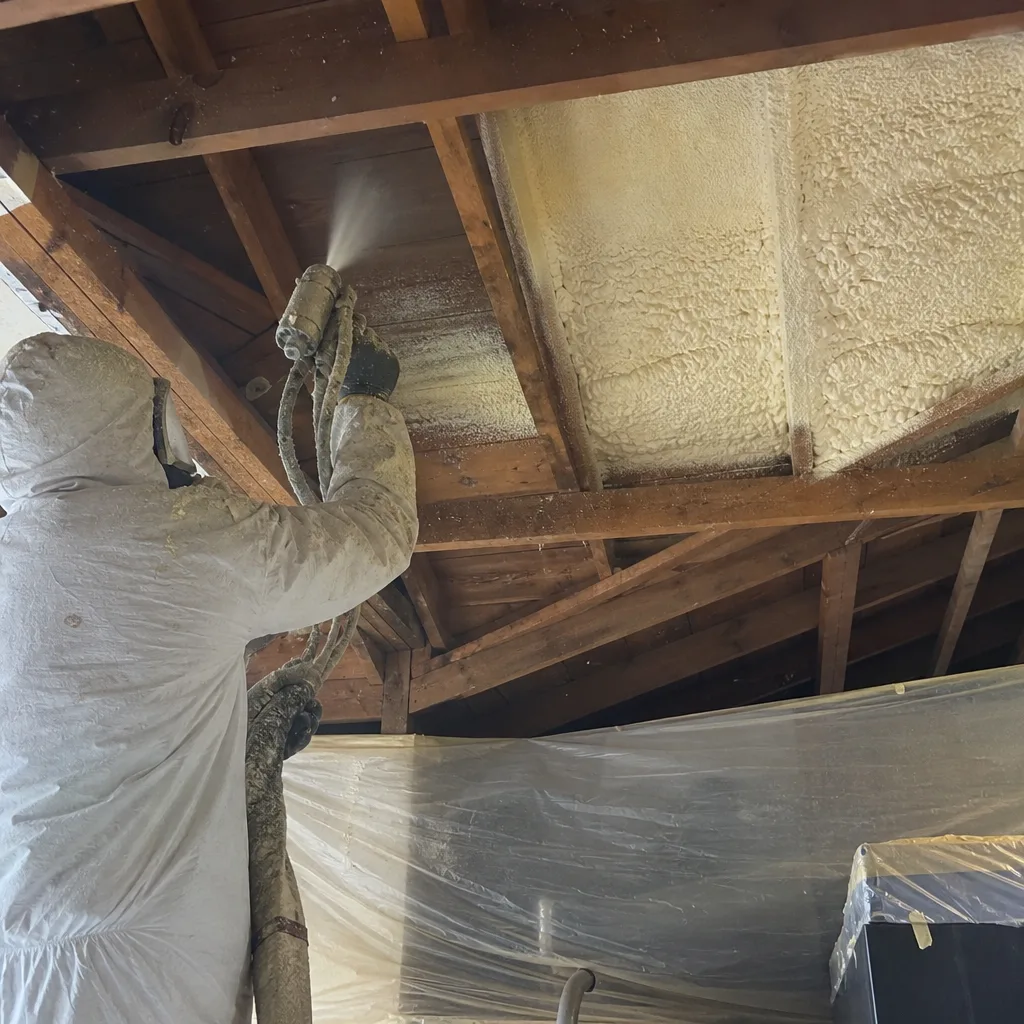
Open-cell spray foam sits at the top of the price range because it’s fundamentally different work. Spray foam insulation is a two-part liquid that expands on contact and seals gaps airtight, which makes it the only material that does double duty as insulation and air sealant in one step. In Fresno homes where HVAC ductwork runs through the attic, spray foam applied to the roofline can dramatically reduce cooling load by bringing the ducts inside the conditioned envelope. Products like Demilec’s open-cell formulations are common in this application. It’s more expensive up front, but the performance difference is real in a climate where summer cooling dominates the utility bill for five to six months a year.
Why Square-Foot Pricing Misleads Homeowners
“What do you charge per square foot?” is the single most common question we hear, and it’s also the least useful question for comparing bids. Here’s why: a square foot of attic floor is not a uniform unit of work. One square foot in the center of an open attic takes seconds to cover. One square foot in a tight corner under a low-pitch roof deck takes minutes. One square foot that requires removing old, contaminated material first takes even longer.
When a contractor quotes per square foot, they’re averaging all of that complexity into one number. Two contractors quoting the same attic can arrive at wildly different averages because they’re making different assumptions about what that average includes. One might assume easy access and no removal. Another might assume the worst-case scenario. You can’t tell from the number alone.
What to ask for instead: a written line-item bid that separates materials, labor, access conditions, preparation, and any additional services. A line-item bid forces the contractor to state their assumptions. You can then ask the right follow-up: “Why is access priced at four hours when the other guy quoted two?” Maybe the other guy hasn’t looked in the attic yet. Maybe this contractor is padding. Either way, the line-item format gives you the leverage to find out.
At Woolsey, we deliver a written price before any work starts, every single time, with no exceptions. That price states the material type, the target R-value, the square footage assumed, the access conditions we observed, and exactly what’s included. No door-step change orders, no surprise line items when the crew arrives. The Kingswell Way is straightforward: say the price, show up in the window, leave it cleaner than you found it, put the guarantee in writing, and come back if it fails.
Hidden Line Items Contractors Don’t Volunteer
Three services show up on final invoices more often than they show up on initial quotes. They’re legitimate work, and they add real value, but you deserve to know about them before they appear. Here’s what to look for in any Fresno insulation bid.
Air Sealing
Air sealing is the practice of closing the small gaps where conditioned air leaks out of your living space into the attic: around recessed lights, plumbing penetrations, electrical boxes, and the tops of interior walls. It’s often sold separately from insulation, and it’s one of the most important performance upgrades you can make in a Fresno home, where stack effect pulls cool, conditioned air out of the house and draws hot attic air down through the ceiling in summer.
Expect to pay $250 to $700 for comprehensive air sealing on a typical 1,500-square-foot home, depending on how many penetrations need work. If a bid doesn’t mention air sealing, ask whether it’s included. If it’s not, ask why, because insulation without air sealing is like wearing a down jacket with the zipper open: it works, but not as well as it should in Fresno’s climate.
Haul-Away of Old Material
If your project requires removing old insulation, that material has to go somewhere. Removal labor is one thing; disposal is another. Dump fees, bag costs, and transport time typically add $100 to $300 to a removal job in the Fresno area. Make sure the bid states whether haul-away is included or separate.
Attic Hatch Insulation Re-installation
The attic hatch or scuttle cover is one of the biggest sources of air leakage in a Fresno home. A standard 22-by-30-inch opening with an uninsulated cover can leak as much conditioned air as a small window left open year-round. A proper attic insulation job includes insulating and weather-stripping the hatch cover itself. This small item, often $50 to $150 in materials and labor, is one of the highest-value upgrades per dollar in the entire project. If your bid doesn’t mention the hatch, ask about it.
Checking R-Value Depth for Fresno’s Climate Zone 13
Fresno sits in California’s Climate Zone 13, which the California Energy Commission defines as the San Joaquin Valley’s hot, dry central region. Title 24, California’s building energy code, currently requires new construction attics in this zone to insulate to R-38 minimum, with R-49 recommended for homes using significant heating in winter. For full details on permits and compliance, read our guide to Insulation Permits, Codes & Inspections in CA: What You Need to Know. For existing homes, there’s no legal requirement to upgrade, but the practical guidance is the same: R-38 is the floor, R-49 is the ceiling of what most Fresno homeowners will ever need.
Here’s what that means in practical terms:
- R-38 blown-in cellulose: approximately 11 to 13 inches of material, depending on settling
- R-38 blown-in fiberglass: approximately 14 to 16 inches, because fiberglass settles more than cellulose
- R-49 blown-in cellulose: approximately 15 to 18 inches
- R-30 fiberglass batts: 9.5 inches thick, standard for pre-2000 construction
The one number every Fresno insulation bid should state explicitly is the target R-value, not just the material depth. Depth without R-value is meaningless because different materials deliver different thermal performance per inch. A bid that says “blow 12 inches of insulation” doesn’t tell you whether you’re getting R-38 or R-44. A bid that says “insulate to R-38 minimum” gives you a measurable standard you can verify when the job is done.
Don’t be afraid to check depth after the job is finished. A tape measure pushed into the material in five or six spots will tell you if the R-value promise was kept. Good contractors expect this. In fact, good contractors want you to check. We leave a job site ready for measurement, with material depth consistent across the entire attic floor, including those hard-to-reach edges under low-pitch roof sections, because that’s where shortcuts happen most often in Fresno homes.
How to Compare Bids Fairly: A Step-by-Step Method
Comparing insulation bids in Fresno doesn’t require technical expertise. It requires a consistent framework. Here’s the exact process we recommend for any homeowner getting quotes for attic insulation work.
Step 1: Document What You Have Before Calling Anyone
- Measure your attic floor area. Use the home’s footprint as a rough guide, and subtract for garage space if the garage has no attic above it.
- Look inside the attic. Note the existing material type, approximate depth in inches, and whether you see any water stains, rodent droppings, or compressed areas.
- Measure your attic access opening dimensions. Write down the type of access: scuttle hole, pull-down ladder, or walk-up stairs.
- Note the roof pitch. If you can see the roof from outside and it looks steep, that’s good news for access. If it looks nearly flat, expect edge work to be slow and priced accordingly.
Step 2: Ask Each Contractor the Same Three Questions
- “What material and R-value are you quoting, and how many inches of depth does that require?”
- “What access conditions are you assuming, and did you physically inspect my attic before quoting?”
- “What’s included beyond the insulation itself: air sealing, removal, haul-away, hatch insulation, and any repairs?”
Step 3: Normalize the Bids
Take each line-item bid and create a simple comparison: same material type, same R-value, same included services. If one quote doesn’t state the material or R-value, ask for it in writing before comparing. If a contractor refuses to put assumptions in writing, that’s your answer. The Kingswell commitment to a written price before any work starts exists for exactly this reason: it removes ambiguity and lets you compare honestly.
Step 4: Check Depth After the Job
Walk through the attic after installation with a tape measure. The material should be consistent across the entire floor. Pay special attention to edges and corners, which are the most common places for shortcuts. If depth is short in multiple spots, call the contractor immediately. Our 365-Day Done Right Promise exists for this exact scenario: if it’s not done right, we make it right, in writing, at no charge, for a full year after installation.
Common Mistakes to Avoid
- Pricing over the phone without an attic inspection. Any contractor who gives a firm quote without looking in your attic is either guessing or protecting themselves with a high number. The Fresno homes we’ve walked through vary too much from house to house for phone pricing to be accurate.
- Comparing bids that assume different R-values. A $1,400 quote for R-30 and a $2,900 quote for R-49 are not competing bids. They’re different projects. Normalize the R-value first, then compare price.
- Skipping air sealing to save $400. In Fresno’s summer heat, unsealed attic air leaks account for a significant share of cooling loss. Insulation without air sealing leaves performance on the table, and the savings disappear into your PG&E bill within two or three summers.
- Accepting a bid that doesn’t specify material type. “Attic insulation” can mean ten different products at five different performance levels. A bid that doesn’t name the material is not a legitimate bid. Ask for the brand name, like GreenFiber cellulose or Owens Corning fiberglass, and the R-value target.
- Ignoring the attic hatch. Homeowners obsess over square footage and forget that a 22-by-30-inch opening is leaking conditioned air every minute of every day in a Fresno summer. Insulating and weather-stripping the hatch is a $50 to $150 item that often delivers more comfort per dollar than any other single upgrade.
- Choosing the lowest bid without reading what’s excluded. A low bid that excludes removal, haul-away, and hatch insulation isn’t a low bid. It’s a partial quote. Read the exclusions line by line before deciding.
- Not asking for the guarantee in writing. Verbal promises don’t survive contact with a hot Fresno attic in July. Whatever the contractor promises, get it on paper. We include a written guarantee on every job we do in Fresno, and our 365-Day Done Right Promise covers any repair or installation issue for a full year, at no charge.
When to Call a Professional
Attic insulation is not a DIY project for most Fresno homeowners. The work takes place in a confined, 140-degree space during summer months. It requires moving equipment, managing material that creates airborne dust, and working around electrical wiring, recessed lights, and framing members. If your attic has less than R-38 of insulation, if your cooling bills have crept upward year over year, if you notice temperature differences between rooms in summer, or if you’ve never looked in your attic and don’t know what’s up there, it’s time to call a professional for an assessment. Attic insulation in Fresno is what we do every day, and Woolsey Insulation Fresno offers free estimates. Call (559) 785-2658 and a live person will answer, 24 hours a day, 7 days a week. No voicemail maze, no call-back window, just a straight answer.
Frequently Asked Questions
Most attic insulation jobs in Fresno run between $1,200 and $3,500 for a standard 1,500 to 2,000 square foot home, depending on material type, access conditions, and whether old material needs removing before new insulation goes in. Call (559) 785-2658 for an exact written quote. Estimates are free, and the price you get is the price you pay.
It depends on what’s up there. If existing material is dry, clean, and just below target depth, topping up with blown-in cellulose is significantly cheaper than removal and replacement. If the material is compressed, water-damaged, or contaminated by rodents, removal and replacement is the only option that solves the problem rather than covering it up. We’ll tell you which situation you have and put the recommendation in writing before any work starts.
R-38 is the minimum practical target for attics in Fresno’s Climate Zone 13, with R-49 recommended if you heat significantly in winter or want maximum summer cooling efficiency. The California Energy Commission sets R-38 as the floor for new construction in this zone, and the same standard makes sense for existing homes.
In most cases, yes. We serve the entire Fresno metro area, including Clovis, Sanger, Kerman, and the surrounding communities. Call (559) 785-2658 and a live person will schedule your free estimate. We’ll inspect the attic, measure the space, and give you a written price before any work begins.
A standard blown-in cellulose job on a 1,500-square-foot Fresno attic takes one day for a two-person crew, including setup, installation, and cleanup. Spray foam insulation on the roofline typically takes one to two days, depending on roof geometry and access. We’ll give you a committed arrival window and leave the job site cleaner than we found it, every time.
Yes, significantly. In a climate where summer temperatures routinely exceed 100 degrees for weeks at a time, a properly insulated and air-sealed attic can reduce the cooling load on your HVAC system by 20 to 30%, depending on how much insulation was there before and how leaky the attic is. The savings show up directly in lower PG&E bills from May through October.
The Bottom Line
Attic insulation in Fresno is not a commodity where the lowest price wins. It’s a performance investment where the right material, the right depth, and the right installation quality determine whether you feel the difference every summer. Fresno homeowners who know the three real cost drivers – access difficulty, removal requirements, and existing material density – can compare bids fairly and spot the difference between a low quote and a bad quote. A written bid that states material type, target R-value, access assumptions, and included services is the single most important tool you have. Everything else is guesswork. And if you want a company that puts it all in writing and answers the phone at 3 a.m., we’re here.
Written by Glenn Hartley, Owner at Woolsey Insulation Fresno, serving Fresno since 2002. Browse more guides & resources on our blog.