
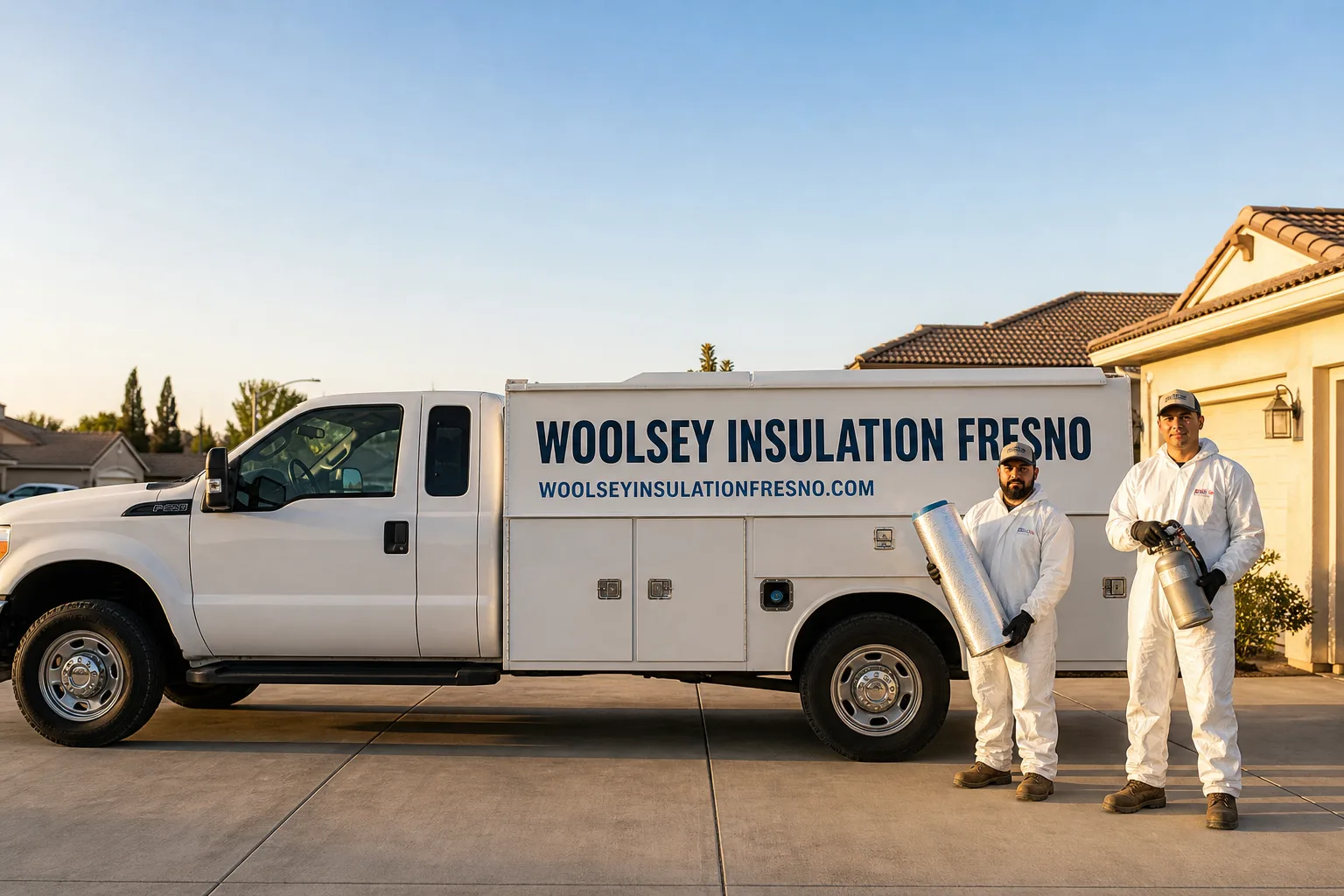
Fast, Reliable Spray Foam Insulation Across Madera
If you own a home in Madera, you’ve probably felt it: the air conditioner running nonstop from June through September while upstairs rooms stay hot and the electric bill keeps climbing. In most cases, the problem isn’t your HVAC system. It’s what’s missing in your attic and walls. Spray foam insulation in Madera typically runs $2,800 to $7,500 for a full attic retrofit, and closed-cell foam on rim joists is the single highest-ROI upgrade we install in this city. Call (559) 785-2658 and we’ll give you a written price before any work begins.
Woolsey Insulation Fresno works throughout Madera, from the older ranch homes west of Highway 99 to the newer subdivisions on the east side. Our crews know which houses need air sealing first, which attics have settled rock wool, and where hot Valley air sneaks in through rim joists. We answer the phone 24/7 and show up when we say we will. Every job gets a written guarantee, in writing, for 365 days.
Key Takeaways:
- Most Madera spray foam retrofits run between $2,800 and $7,500, with closed-cell rim joist work starting around $1,200.
- Older ranch homes in Parkwood, near the fairgrounds, and west of 99 often have under three inches of effective attic insulation.
- Addressing settled rock wool and rim joist leaks can cut cooling bills by 40% in Madera’s Central Valley climate.
- We put a written price in your hand before any work starts, and a 365-Day Done Right Promise on every job.
Why Woolsey Insulation Fresno Is Madera’s Preferred Spray Foam Insulation Company
Since 2002, Woolsey Attic Insulation has worked as part of the Kingswell family of independently owned and operated insulation companies. We install and service attic insulation and Spray Foam Insulation only. We don’t do roofing, windows, or HVAC. That focus is why Madera homeowners call us when they want the insulation job done correctly the first time.
Our Madera customers tell us the same thing: another contractor quoted a price over the phone, then raised it at the door. We don’t do that. Before any work starts in your home, you receive a written price. No door-step surprises, no last-minute add-ons. If the work isn’t right within 365 days, we come back and fix it at no charge. That’s the Kingswell Guarantee, and it’s written on every job.
Every technician who enters your home is background-checked and uniformed. You’ll know who is walking through your door. And when you call (559) 785-2658, a live person answers. Not a voicemail maze, not an automated system. We coordinate scheduling and dispatch from our Fresno, Central Valley office, and crews serve Madera locally, with response times measured in hours for most neighborhoods.
Spray Foam Wall Insulation in Madera
Spray Foam Wall Insulation in Madera is the most direct fix for homes with little to no insulation in exterior walls, a problem we see constantly in older downtown Victorians and 1950s-era ranch construction. The process involves drilling small access holes, injecting closed-cell spray foam, sealing each opening, and patching cleanly. In Madera, wall insulation retrofits typically run $4,000 to $9,000 depending on square footage and wall depth.
Closed-Cell Foam for Older Walls
Closed-cell foam adds structural rigidity and an air barrier while insulating. For Madera homes with uninsulated wall cavities, it’s often the only retrofit option that fits without tearing out drywall. Glenn Hartley oversees every wall job to confirm the foam reaches each cavity completely.
Open-Cell Foam for Interior Walls
Open-cell foam works well for interior soundproofing and newer additions that already have exterior sheathing but need air sealing. It’s slightly less expensive than closed-cell, running about $1.50 to $2.50 per board foot in Madera.
Rim Joist Spray Foam in Madera
Rim Joist Spray Foam in Madera seals the gap where your foundation meets the floor framing, the exact spot where hot, dusty Central Valley air infiltrates wall cavities and makes your insulation work harder than it should. In Madera’s tract homes and ranch houses, poorly sealed rim joists are one of the most common energy leaks we find, and a full rim joist foam job runs $1,200 to $3,000 for most homes.
Where the Air Actually Gets In
Every home has a rim joist: the wooden band around the perimeter between floors. In Madera’s hot summers, unconditioned air pushes through cracks and gaps in that band, making your living space warmer and your AC run longer. Closed-cell spray foam adheres directly to the wood and seals it permanently.
What a Rim Joist Fix Looks Like
Our crew accesses the rim joist from the crawlspace or basement, cleans the surface, and applies two to three inches of closed-cell foam. The job usually takes one day for a single-story Madera home. You’ll notice the difference within the first billing cycle, especially if your floor feels warm in summer.
Trusted Brands We Service in Madera
We install and service spray foam from Owens Corning, Johns Manville, and Knauf, among others. We stock foam for Madera jobs in our Central Valley supply chain so there’s no waiting on material when your project starts. Whether you have an existing Rockwool batt installation that needs removal before foam goes in, or you’re starting fresh with open-cell or closed-cell product, we match the material to your home’s specific needs. We don’t push one brand because it’s on the truck. We choose what fits your attic, your walls, and your budget.
Common Spray Foam Insulation Problems We See in Madera Homes
- Settled rock wool in older ranch attics. West-side homes near Parkwood and the fairgrounds often have only a few inches of effective insulation. When rock wool compacts from decades of Madera heat, it loses most of its R-value. Air conditioners short-cycle and fail prematurely. The fix is removing the old material and air-sealing the ceiling plane before spraying new foam.
- Poorly sealed rim joists in tract homes. Hot Valley air pours through foundation gaps, entering wall cavities and making interior temperatures inconsistent. Spray foam on the rim joist stops the infiltration at the source. Until those gaps are foamed, even new attic insulation underperforms.
- Winter condensation on uninsulated ducts. Madera’s cool, foggy winters create moisture on ductwork running through older attics. That condensation leads to rust and mold. Closed-cell foam applied around the duct perimeter, not over it, protects the insulation and the air you breathe.
- Open-cell foam installed as a vapor barrier. Some Madera homes had spray foam applied incorrectly in past years, especially open-cell product in crawlspaces where moisture is present. Open-cell foam allows vapor to pass, which is correct for walls and attics but wrong for damp crawlspace conditions. We evaluate each space before recommending a foam type.
Pricing for Spray Foam Insulation in Madera, CA
Here’s what Madera homeowners can expect to pay for common spray foam work:
- Attic retrofit (open-cell): $2,800 to $5,500 for a typical 1,400 to 2,000 square foot ranch
- Attic retrofit (closed-cell): $4,500 to $7,500, especially when you need a vapor barrier or roof deck application
- Rim joist sealing: $1,200 to $3,000 depending on home footprint and accessibility
- Wall insulation retrofit: $4,000 to $9,000 for exterior walls in older Madera homes
- Garage ceiling or roof deck spray foam: $1,500 to $3,500
These are Madera market ranges, not placeholder numbers. Your exact written price depends on square footage, foam type, and accessibility. Call (559) 785-2658 for a free estimate. We give you the number in writing before any work starts. That’s a promise, not a sales pitch.
We Also Serve Cities Near Madera
While this page focuses on Madera, our crews work throughout the Central Valley. Call us from Fresno, Clovis, Kerman, or Chowchilla and we’ll bring the same upfront pricing and written guarantee. If you’re in a newer east-side Madera subdivision or an older ranch off Yosemite Avenue, we’ll come take a look.
Serving Madera, CA - Our Local Coverage Area
We’re based in the Madera area and know this community well. Use the map below to see our service coverage - if you’re nearby, we can almost certainly help.
FAQs About Spray Foam Insulation in Madera
Older ranch homes in Madera almost always require removal of settled rock wool or degraded fiberglass batts before new foam can be applied. That removal adds labor and disposal costs. New construction doesn’t have that step. Expect to pay roughly 20 to 30 percent more for an older Madera home retrofit than for a new-build install. Call (559) 785-2658 and we’ll give you an exact written number for your specific attic.
No. Spray foam needs direct contact with the ceiling plane or roof deck to form an effective air seal. Rock wool that has settled or compacted must be removed first. In Parkwood and other west-side Madera neighborhoods, we routinely find rock wool compressed to under three inches. Removing it is part of what makes the retrofit work. We’ll show you what’s up there before we recommend anything.
A closed-cell rim joist seal is the fastest, most cost-effective upgrade we offer in Madera. For most single-story homes, the job takes one day and runs between $1,200 and $3,000. The foam seals the gap between foundation and framing, stopping hot air infiltration at the source. It’s the first fix we recommend for homes with warm floors or high cooling bills.
Most Madera homeowners notice a difference within the first full billing cycle after installation. When we air-seal the ceiling plane and add foam in place of settled rock wool, the AC runs noticeably less, sometimes within days. In the Parkwood attic we recently completed, the homeowner’s July cooling bill dropped by nearly half. Your results depend on your home’s condition, but the change is usually fast and measurable.
Yes. Closed-cell spray foam acts as a vapor barrier and air seal, reducing the amount of moisture that condenses on ducts and sheathing during Madera’s foggy winter months. In vented attics, open-cell foam paired with proper ventilation handles moisture differently. We’ll recommend the right foam type for your attic’s specific ventilation setup after a thorough inspection.
The Madera Spray Foam Difference
In Madera, spray foam insulation work is concentrated in older ranch homes west of Highway 99 where 1950s through 1970s construction left attics with only a few inches of settled rock wool. That forces air conditioners to run continuously from June through September, and it makes closed-cell foam retrofits the most cost-effective fix. Newer east-side subdivisions don’t face the same challenge. They were built to more recent energy codes. But the older homes, the ones that define so much of Madera’s housing stock, need a different approach: remove the degraded material, air-seal the ceiling plane, and spray foam that fits the attic’s structure.
We recently sealed and insulated an attic in the Parkwood subdivision where the original rock wool had compacted to less than three inches. Our crew removed the degraded material, air-sealed the ceiling plane, and applied 5 inches of open-cell spray foam from the Owens Corning line. The homeowner’s July cooling bill dropped by nearly half, and the upstairs bedrooms finally stayed cool through the Valley heat. That’s the kind of result we aim for on every Madera job.
If you own a 1950s-through-1980s home in Madera, whether it’s a ranch near the fairgrounds, a Victorian downtown, or a tract house in a west-side subdivision, you’re likely paying more for cooling than you should. Let us take a look. We’ll give you an honest assessment and a written price before any work begins. Wool was the first insulation. Woolsey keeps the idea in the name. And we’ve been doing this work, the right way, since 2002.
Call Woolsey Insulation Fresno for Your Madera Home
You deserve an insulation contractor who picks up the phone, shows up on time, and puts the price in writing before touching anything. That’s how we operate on every Madera job. Call (559) 785-2658 today for a free estimate. A real person answers, 24 hours a day, 7 days a week.
Written by Glenn Hartley, Owner at Woolsey Insulation Fresno, serving Madera since 2002.